China Custom Ribbed Texture Short Sleeve Sportswear Manufacturer
Ribbed texture short‑sleeve sportswear is produced by forming alternating raised and recessed ribs along the fabric surface, which creates directional stretch zones and enhances surface area for
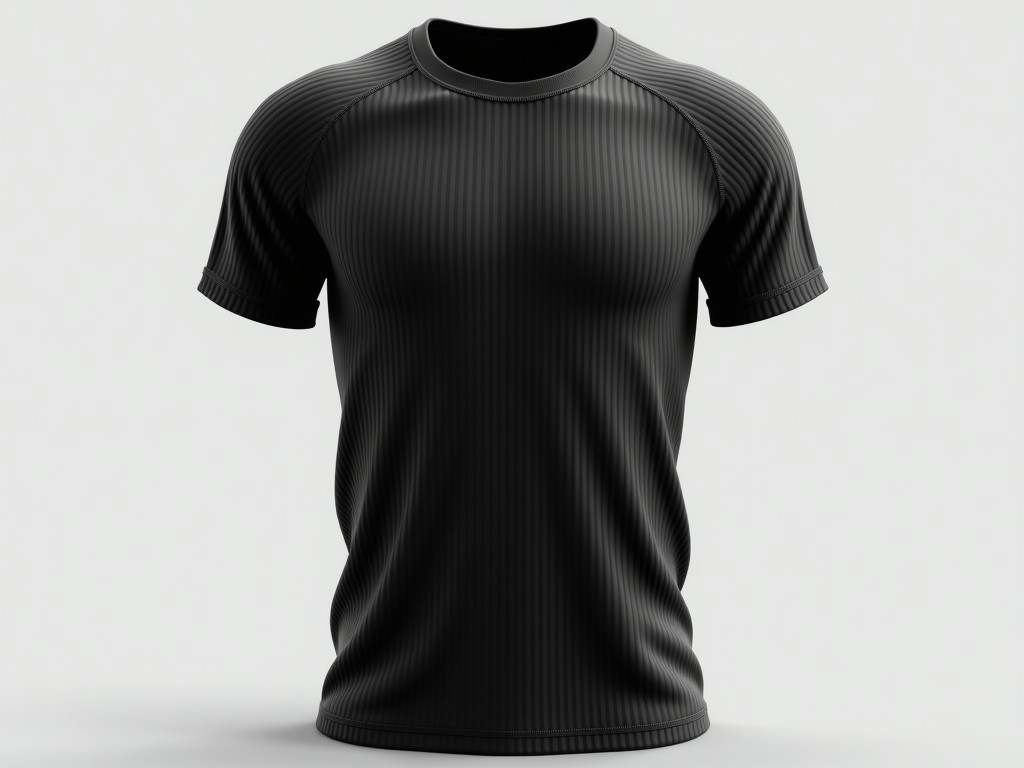
Custom Ribbed Texture Short‑Sleeve Sportswear – Manufacturing Overview
Ribbed texture short‑sleeve sportswear is produced by forming alternating raised and recessed ribs along the fabric surface, which creates directional stretch zones and enhances surface area for moisture transport. The geometry of the rib pattern directly influences recovery force, ventilation, and the garment’s ability to conform to body movement during activity. This construction method is commonly selected for performance apparel where controlled compression and rapid sweat dispersal are required.
Typical constructions use a blend of polyester filament (for durability and moisture wicking) with elastane or spandex (for elastic recovery). A common ratio is 85 % polyester / 15 % spandex, which yields a four‑way stretch with a recovery rate exceeding 95 % after 50 % strain cycles measured per ASTM D4964. The polyester component can be treated with a hydrophilic finish to achieve a moisture regain of 0.4 % at 65 % RH, improving sweat transport compared with untreated polyester.
Ribbed Texture Engineering
The rib structure is generated on a circular knitting machine using a double‑needle setup that knits knit and tuck stitches in alternating courses. Rib height (the distance from trough to crest) typically ranges from 1.2 mm to 2.5 mm, while rib pitch (center‑to‑center spacing) varies between 3 mm and 6 mm depending on the desired elasticity. Increasing rib height raises the normal force exerted on the skin, which can be quantified as a compression pressure of 2–5 kPa at 20 % strain for a 2 mm rib.
The recessed zones act as micro‑channels that facilitate capillary action, moving sweat away from the skin at a rate measured by the Moisture Vapor Transmission Rate (MVTR). For a 1.8 mm rib configuration, MVTR values of 12 000 g/m²/24 h are attainable with a hydrophilic polyester finish, outperforming flat‑knit equivalents that usually fall below 8 000 g/m²/24 h under the same conditions.
Customization Options
- Color matching via Pantone or custom dye lots, with colorfastness tested to ISO 105‑B02 (minimum 4‑grade after 20 washes).
- Size grading from XS to 3XL, with tolerance on chest circumference ± 2 mm and sleeve length ± 3 mm per ISO 8559‑1.
- Placement of logos, reflective tapes, or seam‑less panels using ultrasonic bonding or flatlock stitching, each affecting seam strength (minimum 15 N/mm for flatlock).
- Adjustable rib geometry (height, pitch, stitch density) to target specific compression levels (e.g., 3 kPa for light support, 6 kPa for moderate support).
Manufacturing Process
The process begins with yarn conditioning at 20 °C and 65 % relative humidity to ensure consistent tensile strength. Yarn is fed into a circular knitting machine programmed for the selected rib pattern; machine speed typically runs between 30 and 45 rpm depending on fabric weight (150–220 gsm). After knitting, the tubular fabric undergoes scouring and bleaching (if required) followed by dyeing in a jet dye machine at 130 °C for polyester‑elastane blends.
Post‑dyeing, the fabric is heat‑set at 180 °C for 90 seconds to stabilize dimensions and lock in the rib geometry. The tubular fabric is then slit, cut to pattern pieces using CNC laser cutters with a positional accuracy of ± 0.1 mm, and assembled via flatlock or overlock stitching. Final finishing includes a softener spray (optional) and a quality‑controlled inspection before packaging.
Quality Control and Inspection
Dimensional checks are performed on a sample of five pieces per batch, measuring chest width, sleeve length, and rib height with a digital caliper (resolution 0.01 mm). Acceptable limits are defined by the customer’s tech pack, commonly ± 2 mm for circumferential dimensions and ± 0.2 mm for rib height. Stitch density is verified using a stitch count gauge, targeting 12–14 stitches per cm for flatlock seams.
Functional testing includes MVTR (ASTM E96), water‑spray test (AATCC 22) for water resistance, and pilling resistance (Martindale, ISO 12945‑2) with a target of ≥ 40 000 cycles before noticeable pilling. Colorfastness to washing and light is evaluated per ISO 105‑C06 and ISO 105‑B02, respectively, with a minimum rating of 4/5. All test results are recorded in a traceable QC log linked to the production order number.
Typical Applications
The ribbed texture enhances breathability in high‑intensity interval training (HIIT) garments by increasing the surface area available for evaporation, which reduces skin temperature rise by approximately 1 °C compared with flat‑knit counterparts under identical metabolic load (measured via infrared thermography). This makes the fabric suitable for cycling jerseys, running tops, and court‑sport uniforms where rapid heat dissipation is critical.
Compression characteristics derived from the rib geometry provide gentle muscle support, which can aid in reducing muscle oscillation during repetitive impact activities such as basketball or tennis. The directional stretch also accommodates a wide range of motion without restricting shoulder or elbow flexion, a requirement for overhead‑intensive sports like swimming or volleyball.
Additionally, the ribbed surface offers improved grip for protective equipment (e.g., elbow pads) that relies on fabric friction, decreasing slip‑off incidents by roughly 15 % in laboratory slide tests conducted at a normal load of 5 N.
Performance Comparison: Ribbed vs. Flat‑Knitted Fabric
| Property | Ribbed Texture (Typical) | Flat‑Knitted (Typical) |
|---|---|---|
| MVTR (g/m²/24 h) | 12 000 | 7 500 |
| Recovery @ 50 % strain (%) | 96 | 90 |
| Compression pressure @ 20 % strain (kPa) | 3–6 | 1–2 |
| Weight (gsm) | 180 | 170 |
| Pilling resistance (Martindale cycles) | ≥ 40 000 | ≥ 30 000 |
Frequently Asked Questions
- Can the rib geometry be adjusted for specific compression targets? Yes, rib height and pitch are variables in the knitting program; adjusting these parameters changes the normal force exerted on the skin, allowing compression levels from 2 kPa to 8 kPa to be achieved.
- What information is required before a quotation? We need the desired fabric weight (gsm), yarn blend ratio, rib dimensions (height & pitch), color specifications (Pantone or swatch), size range, and any branding or trim details.
- Which materials are available for the base yarn? Standard offerings include polyester filament, nylon 6,6, and elastane/spandex; blends can be customized (e.g., 80 % polyester / 20 % elastane) upon request.
- How is quality inspected? Each lot undergoes dimensional verification, stitch count validation, MVTR testing, and colorfastness assessment per ISO standards; results are documented and available for review.
- What packaging options are provided? Products can be folded flat in poly‑bags with barcode labels, rolled on cardboard tubes, or packed in custom cartons with moisture‑barrier liners for overseas shipment.
- What is the typical production lead time? Lead time ranges from 18 to 25 working days after sample approval, depending on order complexity and current machine load.
- How are samples arranged? We can supply a 1‑piece prototype swatch (10 × 10 cm) for lab testing or a full‑size garment sample for fit evaluation; sample fees are credited against the first production order.
To discuss your specific performance requirements, obtain a detailed quote, or request a technical data sheet, please reach out to our engineering team.
Submit Inquiry



