Oem Newest Carbon Pickleball Paddle Supplier
This page details the engineering basis for a new OEM‑grade carbon‑fiber pickleball paddle line, focusing on measurable properties that influence procurement decisions. The paddle face uses a
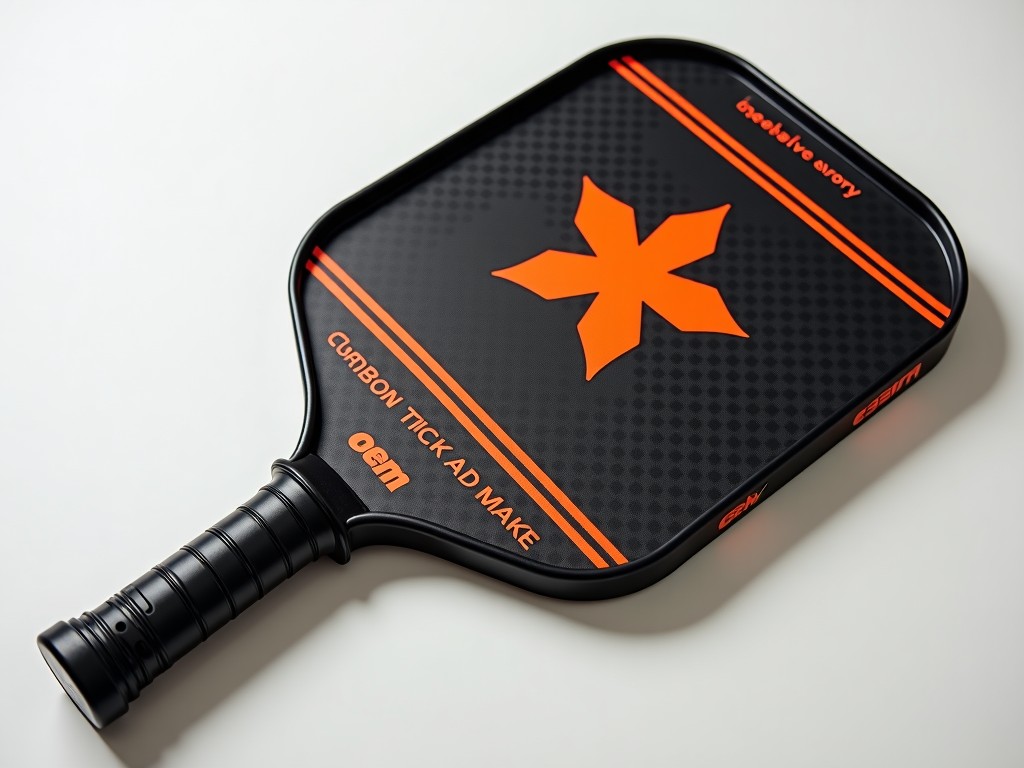
OEM Newest Carbon Pickleball Paddle Supplier
This page details the engineering basis for a new OEM‑grade carbon‑fiber pickleball paddle line, focusing on measurable properties that influence procurement decisions.
Material Composition
The paddle face uses a unidirectional T700 carbon‑fiber fabric impregnated with an epoxy resin system rated for a glass transition temperature of 130 °C. The core is a polypropylene honeycomb with a cell size of 6 mm and a nominal density of 32 kg/m³.
These constituents are selected to achieve a specific flexural modulus of 45 GPa in the face laminate while keeping the overall paddle mass below 220 g.
Manufacturing Process
Layers are cut to a precise 0.125 mm tolerance using a CNC laser cutter, then stacked in a symmetric [0/90]±45 layup to balance in‑plane stiffness and torsional rigidity.
The layup undergoes vacuum bagging and autoclave curing at 120 °C for 90 minutes, followed by post‑cure at 150 °C for 30 minutes to ensure complete resin polymerization.
After curing, the paddle blank is milled to final shape with a 5‑axis CNC router, achieving edge tolerance of ±0.2 mm and surface roughness Ra ≤ 0.8 µm.
Performance Characteristics
Measured static weight averages 210 g with a standard deviation of 4 g across production batches.
Flexural stiffness measured at the paddle’s midpoint yields a load‑deflection slope of 180 N/mm, indicating a responsive feel suitable for rapid volley exchanges.
Vibration damping, assessed via impulse hammer testing, shows a decay time of 12 ms, reducing hand fatigue during extended play sessions.
Customization Options
- Face shape: standard, elongated, or wide‑body, adjustable in 5 mm increments.
- Weight balance: head‑heavy, even, or handle‑biased, achieved by varying core thickness from 12 mm to 18 mm.
- Grip circumference: ranging from 100 mm to 115 mm, with optional perforated or cushioned overlays.
- Surface finish: matte, gloss, or textured spin‑enhancing coating, each defined by a specific roughness profile.
Quality Assurance
Each paddle undergoes a three‑step inspection: dimensional verification, surface defect scanning, and mechanical performance testing.
- Dimensional check: length, width, and thickness measured with a coordinate measuring machine; acceptance ±0.3 mm.
- Surface scan: automated optical system detects delamination, resin voids, or fiber misalignment >0.1 mm².
- Mechanical test: three‑point bend test to confirm flexural modulus within 45 ± 3 GPa; impact resistance measured via Charpy notched test ≥ 12 kJ/m².
Applications
OEM buyers integrate these paddles into branded product lines where consistent weight distribution and predictable rebound characteristics reduce warranty claims and improve player satisfaction.
The paddle’s low vibration transmission and high stiffness‑to‑weight ratio make it suitable for competitive tournament play as well as training equipment requiring repeatable performance over thousands of cycles.
Typical Specifications
| Property | Typical Value | Test Method |
|---|---|---|
| Weight | 210 ± 5 g | ASTM F1894 |
| Flexural Modulus | 45 ± 3 GPa | ISO 178 |
| Impact Resistance (Charpy) | ≥ 12 kJ/m² | ISO 179-1 |
| Vibration Decay Time | 12 ms | Impulse Hammer |
| Core Density | 32 kg/m³ | ASTM D3575 |
Frequently Asked Questions
- Can dimensions be customized? Yes, length, width, and thickness can be adjusted within ±0.3 mm of nominal values based on tooling availability.
- What information is required before quotation? Detailed drawing or CAD model, desired weight balance, grip size, surface finish, and annual volume forecast.
- What materials are available? Standard T700 carbon‑fiber/epoxy face with polypropylene honeycomb core; alternative cores (Nomex, aluminum) and fiber grades (T800, M46J) are offered upon request.
- How is quality inspected? Each paddle undergoes dimensional CMM check, optical surface scan, and three‑point bend test as outlined in the quality assurance section.
- What packaging methods are available? Individual paddles are placed in PE foam sleeves, then packed in corrugated cartons with corner protectors; palletizing options include standard 40 × 48 in or custom configurations.
- How are export shipments protected? Cartons are sealed with moisture‑barrier liners and subjected to ISTA 3A vibration testing to ensure integrity during transit.
- What is the typical production lead time? Tooling preparation requires 3‑4 weeks; subsequent production runs average 10‑14 working days per 5 000 units.
- How are samples arranged? Sample paddles are produced after design approval and shipped via express courier; associated costs are credited against the first production order.
Contact our engineering team to discuss technical specifications, request a formal quotation, or arrange sample evaluation.




