Custom Professional Pickleball Paddle Supplier
A pickleball paddle consists of a core material sandwiched between two face sheets, with dimensions regulated by the USA Pickleball Association (max length 43 cm, max width 20 cm, max weight 240 g).
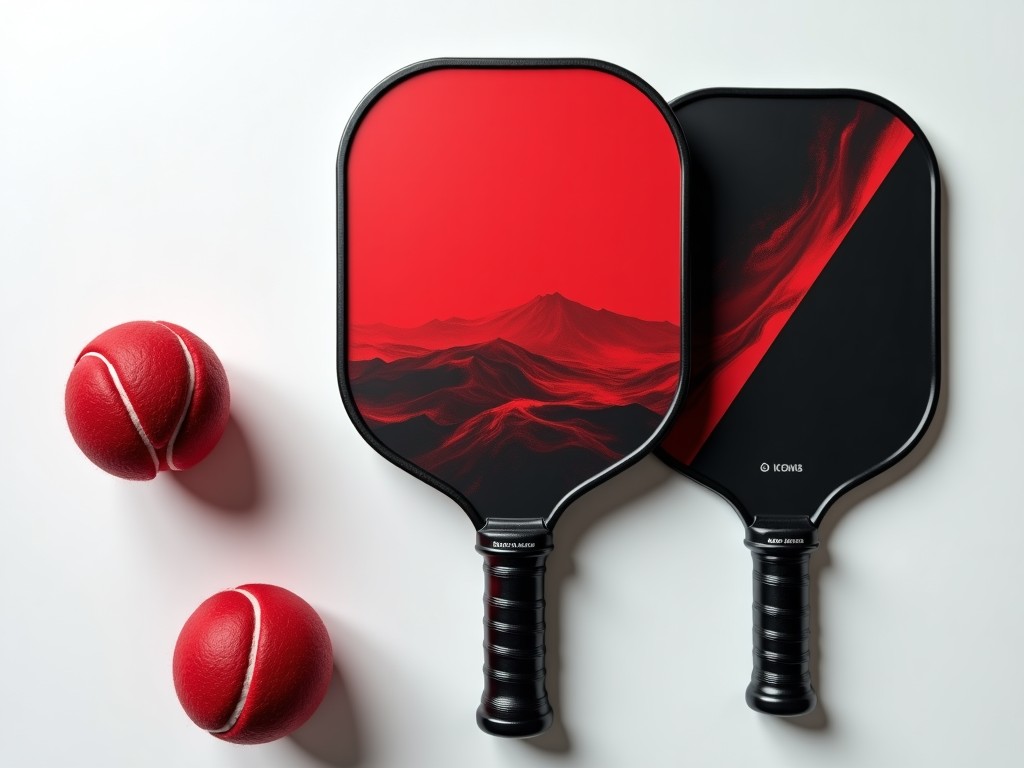
Custom Professional Pickleball Paddle Supplier
A pickleball paddle consists of a core material sandwiched between two face sheets, with dimensions regulated by the USA Pickleball Association (max length 43 cm, max width 20 cm, max weight 240 g). Customization allows the designer to adjust weight distribution, surface texture, and grip geometry to match a player’s swing style and physical characteristics.
Core and Face Material Options
The core determines the paddle’s stiffness and energy return. Common cores are polymer honeycomb (density ≈ 0.03 g/cm³, thickness 12‑16 mm), Nomex® aramid honeycomb (density ≈ 0.04 g/cm³, thickness 10‑14 mm), and aluminum alloy (density ≈ 2.7 g/cm³, thickness 6‑9 mm). Face sheets are typically carbon fiber woven (areal weight 150‑200 g/m², modulus 70 GPa), fiberglass (areal weight 200‑250 g/m², modulus 35 GPa), or graphite (areal weight 120‑180 g/m², modulus 50 GPa). The combination of core thickness and face modulus directly influences the paddle’s sweet‑spot size and vibration damping.
Customizable Performance Parameters
- Target weight: 190‑235 g, adjustable in 2‑g increments via core thickness or face layup.
- Balance point: measured from the butt cap, range 180‑210 mm (head‑heavy to handle‑heavy).
- Grip circumference: 100‑115 mm, with optional tapered or ergonomic profiles.
- Surface texture: silicone‑based grit (roughness Ra 8‑12 µm) for spin, or smooth polymer coating (Ra < 2 µm) for control.
- Edge guard: TPU or rubber strip, width 3‑5 mm, to protect the rim.
- Color and graphics: full‑sublimation printing on the face, spot‑UV logo placement.
Manufacturing Process Overview
First, the core is cut to shape using CNC water‑jet or laser to achieve ±0.1 mm tolerance. Face sheets are pre‑impregnated with epoxy resin and laid up in a vacuum bag; the layup is cured at 120‑130 °C for 45‑60 minutes under 0.8 bar pressure. After demolding, the paddle is trimmed to final dimensions, the edge guard is bonded, and the grip is over‑wrapped with synthetic leather or PU. Each step is monitored with inline thickness gauges and temperature loggers to ensure repeatability.
Quality Control Philosophy
Weight is measured on a analytical balance (±0.1 g). Balance point is determined by a precision pivot fixture (±0.5 mm). Surface flatness is checked with a laser interferometer (peak‑to‑valley < 0.02 mm). Impact resistance is evaluated by dropping a 20 mm steel ball from 1 m height; acceptable paddles show no delamination or cracking. All data are recorded per lot and available to the customer upon request.
Typical Applications
Recreational players benefit from a larger sweet spot and moderate weight (≈ 210 g) that reduces arm fatigue during extended play. Competitive athletes often select a head‑heavy balance (≈ 205 mm) and higher swing weight (> 115 kg·cm²) to generate power on serves and drives. Coaching facilities order batches with uniform grip size and color‑coded faces to simplify drills and skill‑specific instruction.
Comparison of Standard Configurations
| Parameter | Control‑Oriented | All‑Round | Power‑Focused |
|---|---|---|---|
| Core Material | Polymer honeycomb, 15 mm | Nomex® honeycomb, 12 mm | Aluminum alloy, 8 mm |
| Face Material | Fiberglass, 2‑ply | Carbon fiber, 2‑ply | Graphite, 2‑ply |
| Target Weight (g) | 200 ± 3 | 215 ± 3 | 230 ± 3 |
| Balance Point (mm from butt) | 190 ± 2 | 200 ± 2 | 210 ± 2 |
| Swing Weight (kg·cm²) | 95 ± 5 | 105 ± 5 | 115 ± 5 |
| Face Roughness Ra (µm) | 10 ± 2 (spin‑enhanced) | 6 ± 2 (balanced) | 3 ± 1 (smooth for control) |
Frequently Asked Questions
- Can dimensions be customized beyond USAPA limits? No; all paddles must conform to the official length, width, and thickness limits for tournament play. Custom dimensions are available for training or novelty items only.
- What information is required before quotation? Desired weight range, preferred balance point, grip size, core and face materials, surface texture, any logo or color specifications, and order quantity.
- What materials are available for the core? Polymer honeycomb, Nomex® aramid honeycomb, and aluminum alloy, each with selectable thicknesses.
- How is quality inspected? Each lot undergoes weight, balance, flatness, and impact testing; results are documented and shared with the buyer.
- What packaging options are offered? Individual paddle in a PE foam sleeve, placed in a corrugated carton with corner protectors; bulk packs use palletized, stretch‑wrapped cartons for sea freight.
- How are export shipments protected? Cartons are lined with moisture‑barrier film, and pallets are fitted with edge boards and strapping to prevent shifting.
- What is the typical production lead time? 3‑4 weeks for standard configurations; 5‑6 weeks for fully customized layups, subject to material availability.
- How are samples arranged? A single‑piece sample can be produced after receipt of the technical spec sheet; sample cost is credited toward the first production order.
Request a detailed quotation or technical consultation to discuss your specific performance targets and ordering requirements.




