Custom Printed Edgeless Pickleball Paddles Supplier
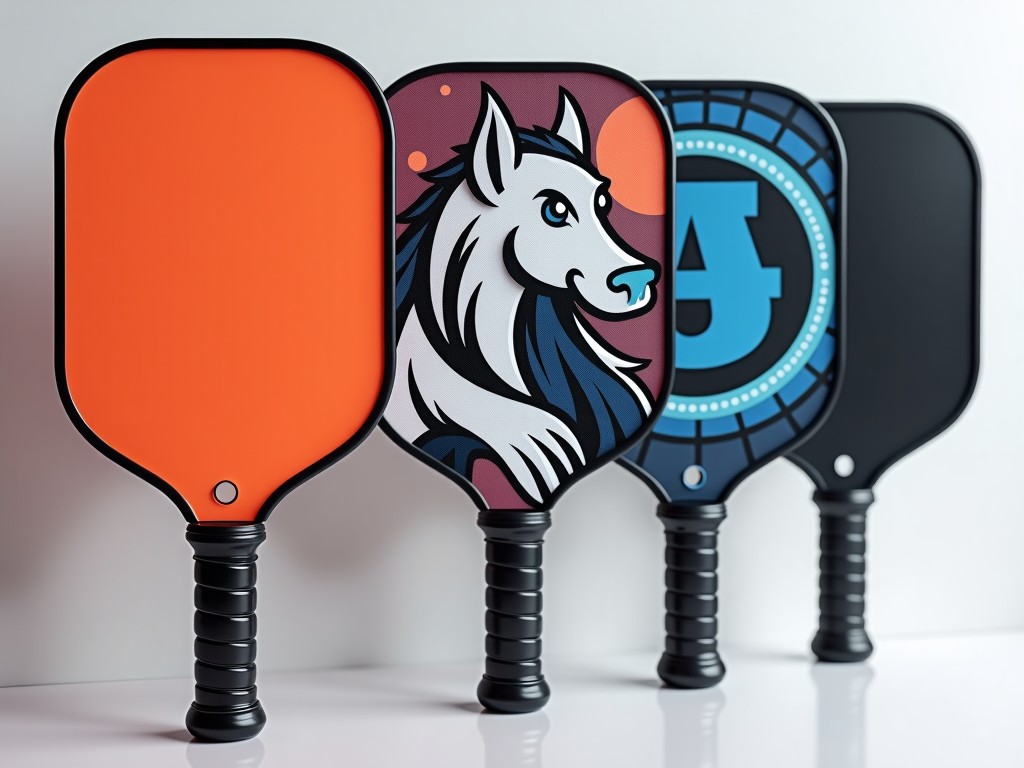
Edgeless paddles eliminate the peripheral rim found on traditional designs, which reduces chipping and creates a larger effective hitting area. The construction typically combines a lightweight core
Custom Printed Edgeless Pickleball Paddles Supplier
Edgeless paddles eliminate the peripheral rim found on traditional designs, which reduces chipping and creates a larger effective hitting area. The construction typically combines a lightweight core with a smooth face that accepts high‑resolution graphics without adding measurable weight.
Core Materials and Construction
The core is usually a polypropylene honeycomb sheet with cell diameters ranging from 6 mm to 8 mm, providing a balance between stiffness and impact absorption. Core thickness varies from 12 mm to 16 mm, resulting in paddle weights between 190 g and 220 g for a standard 40 cm × 20 cm blade.
Material Options
| Core Type | Typical Thickness (mm) | Density (kg/m³) | Resulting Weight Range (g) |
|---|---|---|---|
| Polypropylene honeycomb | 12‑16 | 30‑45 | 190‑220 |
| Nomex aramid honeycomb | 10‑14 | 48‑60 | 200‑235 |
| Polymer foam | 14‑18 | 25‑35 | 180‑210 |
Surface and Printing Technology
The paddle face receives a UV‑curable ink layer typically 15 µm to 25 µm thick, which bonds to a polypropylene or carbon‑fiber reinforced surface. Surface roughness after printing stays below Ra 0.8 µm, ensuring consistent ball spin and minimal drag.
Customization Options
- Full‑color graphics up to 300 dpi, covering the entire face or limited to a logo zone.
- Grip shape options: standard octagonal, tapered, or ergonomic contour with circumference ranging from 100 mm to 115 mm.
- Edge radius can be specified from 0 mm (sharp) to 3 mm (rounded) to match player preference for handling.
- Optional weight‑balancing inserts (tungsten or steel) adjustable in 5 g increments.
Dimensional Tolerances and Performance Specs
| Parameter | Typical Value | Tolerance |
|---|---|---|
| Overall Length | 400 mm | ±2 mm |
| Overall Width | 200 mm | ±2 mm |
| Weight | 205 g | ±5 g |
| Swing Weight (balance point from handle) | 190 mm | ±3 mm |
| Surface Hardness (Shore D) | 78 | ±2 |
Manufacturing Considerations
Core sheets are cut to size, then laminated with the printed face using a hot‑press cycle at 150 °C for 90 seconds, achieving a bond strength exceeding 1.2 MPa. After lamination, the paddle undergoes CNC trimming to final dimensions and a deburring step that removes any flash under 0.1 mm.
Quality Control and Testing
- Visual inspection under 500 lux lighting to detect ink defects, delamination, or surface contamination.
- Dimensional verification with digital calipers on length, width, thickness, and grip circumference.
- Adhesion peel test per ASTM D903, requiring a minimum of 1.0 N/mm.
- Ball rebound consistency measured with a standardized drop test; variation ≤ 3 % across five impacts.
Applications and Use Cases
The edgeless geometry reduces the likelihood of edge chipping during aggressive play, which extends paddle lifespan in high‑frequency environments such as clubs and tournament circuits. The enlarged sweet spot improves shot consistency for recreational players transitioning from beginner to intermediate levels.
Packaging and Logistics
Each paddle is placed in a low‑density polyethylene sleeve with a 50 µm thickness, then packed into a corrugated carton featuring double‑wall construction and corner guards. Cartons are palletized with a maximum load of 800 kg and include silica gel packets to maintain relative humidity below 50 % during transit.
Frequently Asked Questions
Q: Can the paddle dimensions be customized beyond the standard 400 mm × 200 mm?
A: Yes, length and width can be adjusted in 5 mm increments, subject to core material availability and weight constraints.
Q: What file formats are accepted for artwork?
A: We accept PDF, AI, EPS, and high‑resolution PNG (300 dpi) with CMYK color mode.
Q: How is the weight balance verified?
A: Each paddle is measured on a precision balance beam; the balance point is recorded and compared against the target tolerance before packaging.
Q: What is the typical production lead time for an order of 500 paddles?
A: Lead time ranges from 18 to 22 working days, depending on core selection and graphic complexity.
Get a Quote
For technical datasheets, sample requests, or to discuss specific performance targets, please reach out to our engineering team.
Contact Us



