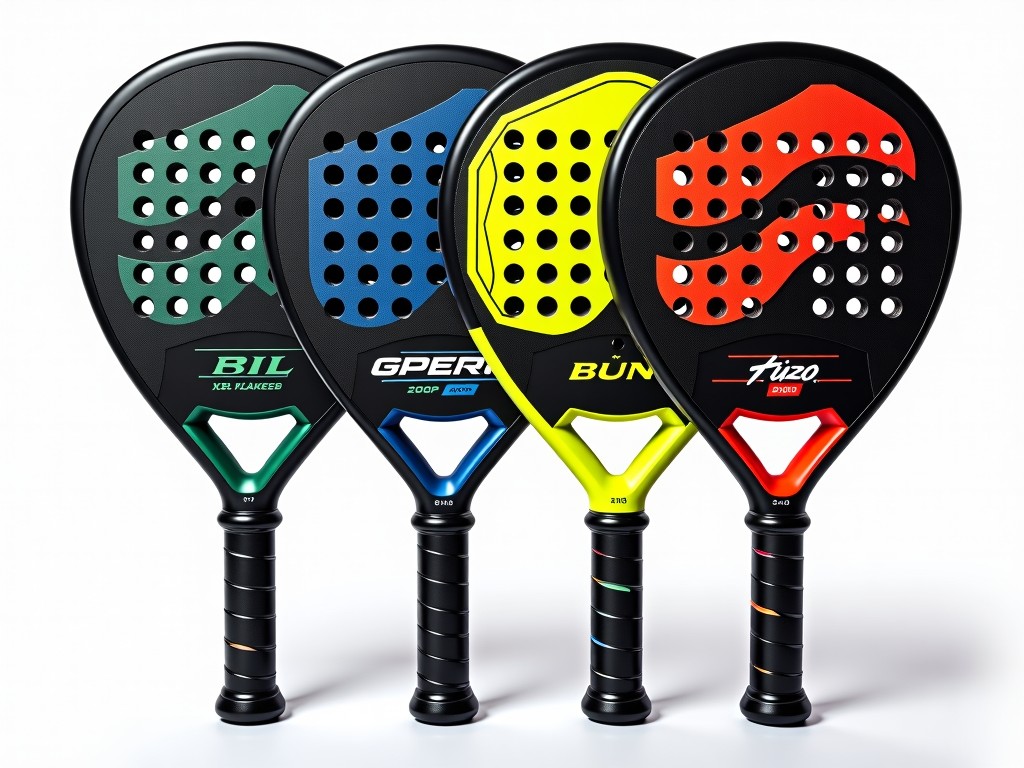
china latest design junior padel racket supplier: Tolerances, Grades and Supply Details
Structural integrity in junior padel rackets hinges on the bond strength between the carbon-fiber shell and the internal foam core. Junior players often exhibit lower swing speeds but higher frequency of impact cycles, which accelerates material fatigue if the resin-matrix interface is not optimized. We utilize a vacuum-pressure infusion process to minimize void formations that typically serve as precursors to delamination in lower-specification molded frames.
Design Constraints Behind the Specification
Interface geometry determines the distribution of shear stress across the carbon-fiber layup. Standard adult-sized specifications often fail to account for the reduced moment of inertia in junior frames, leading to stress concentrations at the throat point. Our design compensates by varying the perimeter wall thickness. If the wall thickness fluctuates beyond ±0.2mm, the resulting weight imbalance can lead to catastrophic failure under high-velocity impact events.
Critical Tolerance Requirement
The core-to-frame interface must maintain a concentricity within 1% throughout the thermal curing cycle. Deviations result in internal air pockets, which compromise the racket's rebound coefficient.
Material Modulus
3K Carbon fiber weave provides the necessary stiffness for junior-level competitive play while preventing frame de-lam during de-loading.
Core Density
EVA foam grades of 22-24 kg/m³ ensure consistent elasticity under the repetitive impact cycles of developing athletes.
Surface Finish
Sandpaper-textured layers increase the friction coefficient for ball control, improving spin without adding significant mass.
Grade Selection Logic for Harsh Service
Dimensional stability depends on the modulus of the EVA foam core relative to the tensile strength of the outer frame. In high-humidity environments, standard elastomers can absorb moisture, leading to a loss of structural rigidity over time. We specify a closed-cell foam structure to prevent water ingress and maintain the racket's weight-balance profile.
Lower-density cores offer a larger sweet spot but suffer from rapid deformation. For professional-grade junior-level rackets, we recommend a medium-density EVA that retains its memory properties after over 5,000 hours of active use.
| Parameter | Standard | OEM Specification |
|---|---|---|
| Frame Weight | 200g avg | 180g - 210g |
| Weight Tolerance | ±10g | ±3g |
| Core Stiffness | Standard EVA | Variable-Density EVA |
| Impact Resistance | Basic | Reinforced-Throat |
Solutions Mapped to Industry Duty Cycles
Load path analysis shows that junior-specific frames experience higher torque concentrations at the throat point. Because junior players often lack optimized technique, the lateral forces exerted on the racket head are inconsistent. We mitigate this by integrating carbon fiber reinforcements in the bridge area to distribute the load across the entire surface area.
High-frequency use in training academies requires specific vibration damping to prevent elbow injuries. Our integration of elastomeric layers within the handle assembly filters out high-frequency oscillations without altering the power-transfer profile of the face.
Working as a Production Partner, Not a Catalogue Supplier
Sourcing junior equipment requires a deep understanding of material behavior under varying thermal conditions. We provide full CAD-based material analysis to ensure that your custom design aligns with manufacturing capabilities. For specific technical requirements, request an engineering consultation today.
Capacity, Tooling and Scheduling
Tooling timelines for carbon-fiber molds are dictated by the complexity of the layup schedule. Using CNC-machined aluminum molds prevents deformation over long cycles and ensures dimensional consistency across large batches. We maintain secondary tooling lines to mitigate risks associated with mold damage during peak demand.
Supply Continuity and Second-Source Planning
Supply chain resilience is maintained by diversifying raw material sources for carbon fiber and specialized resins. This ensures that a disruption in one geographic region does not halt your production line. We maintain a buffer stock of critical components to guarantee delivery schedules even during seasonal fluctuations.




