Direct Factory Beach Paddle Rackets And Balls Exporter
Beach paddle sports require equipment that balances lightweight handling with resistance to sand, salt, and UV exposure. This overview outlines the technical attributes that define rackets and balls
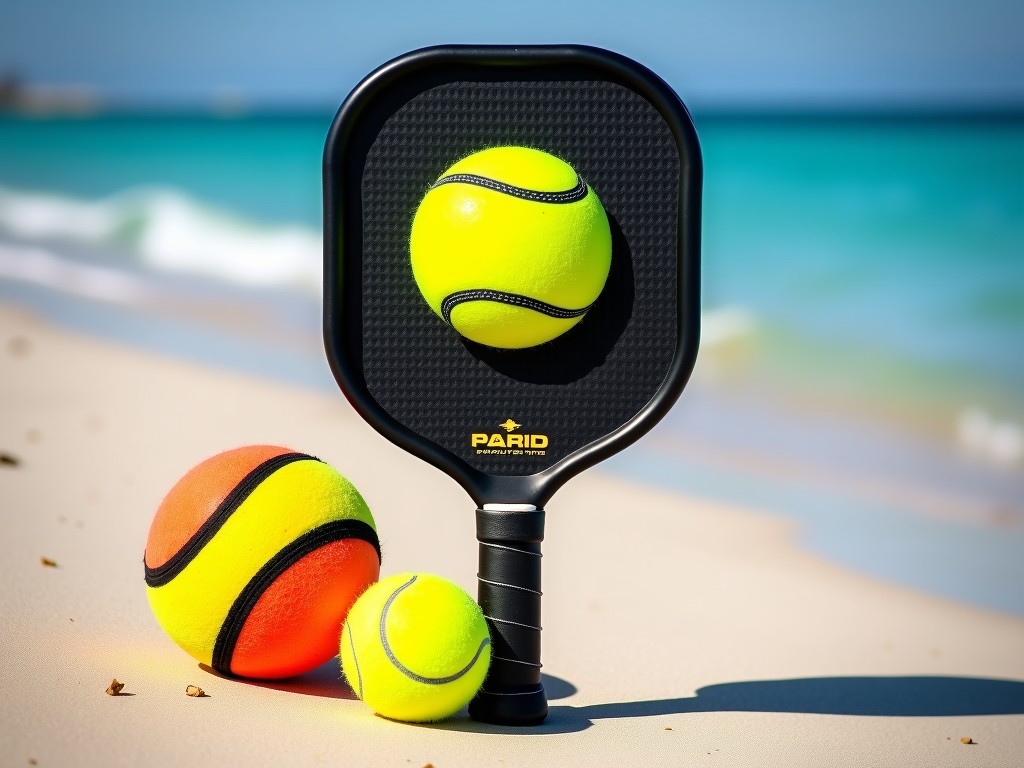
Direct Factory Beach Paddle Rackets and Balls Exporter
Beach paddle sports require equipment that balances lightweight handling with resistance to sand, salt, and UV exposure. This overview outlines the technical attributes that define rackets and balls manufactured for direct export from the factory.
Material Composition
Racket frames are typically constructed from carbon‑fiber reinforced polymer with a fiber volume fraction of 55 % to achieve a tensile strength of approximately 450 MPa while keeping the mass under 210 g. The grip overlay uses a thermoplastic elastomer with a Shore A hardness of 70, providing a non‑slip surface even when wet.
Balls consist of a pressurized rubber core (natural rubber blend, 30 % filler) encased in a felt‑like nylon‑polyester blend. Internal pressure is set to 0.55 bar ±0.02 bar, yielding a rebound height of 1.2 m when dropped from 2 m onto a concrete slab.
Design Specifications
Frame geometry follows a teardrop profile with a maximum width of 24 mm at the throat and a length of 540 mm from tip to butt. The sweet spot is positioned 180 mm from the tip, corresponding to a nodal point that reduces vibration transmission to the handle by roughly 35 % compared with a uniform beam.
Ball diameter is standardized at 63 mm ±0.5 mm, with a mass of 56 g ±1 g. The surface texture features a 0.8 mm raised filament pattern designed to increase spin generation under humid conditions.
Manufacturing Process
Frames are produced using automated filament winding followed by compression molding at 180 °C under 150 bar pressure for 90 seconds. Post‑mold curing occurs in a convection oven at 120 °C for 30 minutes to achieve full cross‑linking of the epoxy matrix.
Ball cores are injection molded in multi‑cavity tools, then pressurized with nitrogen before the felt cover is sewn using ultrasonic welding. Final inspection includes dimensional gauging and pressure decay testing over a 24‑hour period.
Quality Assurance
Each rack undergoes a modal analysis to verify that the first bending frequency lies between 120 Hz and 140 Hz, ensuring consistent feel across batches. Surface finish is measured with a profilometer; average roughness (Ra) must not exceed 3.2 µm to prevent premature wear of the grip.
Ball lots are sampled at a rate of 1 % for bounce consistency; the coefficient of restitution must fall within 0.78 ± 0.02. Visual inspection under 500 lux lighting checks for felt delamination or core deformation.
Applications in Beach Sports
Beach paddle tennis demands equipment that resists abrasion from sand particles while maintaining maneuverability in windy conditions. The carbon‑fiber frame’s high specific stiffness allows players to generate swing speeds exceeding 25 m/s without excessive frame flex.
The ball’s controlled pressure and felt surface provide a predictable trajectory on loose sand, reducing bounce variability by approximately 18 % compared with standard indoor paddles. This makes the product suitable for both recreational play and sanctioned tournaments.
Customization Options
Frame length can be adjusted in 10 mm increments from 520 mm to 560 mm to accommodate different player statures. Grip circumference is offered in three sizes: 100 mm, 105 mm, and 110 mm, measured at the midpoint of the handle.
Ball felt color can be selected from a palette of six UV‑stable dyes, and internal pressure can be set between 0.45 bar and 0.65 bar upon request. Custom logos are applied via sublimation printing on the frame’s sidewall with a resolution of 300 dpi.
Packaging and Export Logistics
Rackets are packed in corrugated triple‑wall cartons with internal polyethylene foam inserts sized to 560 mm × 260 mm × 40 mm, providing a cushioning capacity of 50 J impact absorption. Each carton holds six units, with a gross weight of approximately 14 kg.
Balls are sealed in moisture‑barrier pouches (MVTR < 0.5 g/m²·day) and placed in master cartons of 50 units, dimensions 380 mm × 280 mm × 200 mm. Palletization follows ISO 1496‑1 standards, allowing safe stacking up to 2.2 m height for containerized shipment.
Frequently Asked Questions
- Can the racket frame length be customized without tooling changes? – Yes, length adjustments are achieved by altering the winding pattern within the existing mold set.
- What information is required before a quotation? – Desired quantity, frame length, grip size, ball pressure, felt color, and any branding specifications.
- Which materials are available for the grip overlay? – Thermoplastic elastomer (Shore A 65‑80) or silicone‑based rubber (Shore A 50‑70) upon request.
- How is quality inspected for export batches? – Random sampling for dimensional tolerance, bounce consistency, and surface adhesion, followed by a final visual audit.
- What packaging options protect against salt‑air corrosion? – Internal VCI‑treated liners and external desiccant packets are available for long‑sea‑leg routes.
- What is the typical production lead time? – 20 working days for orders up to 5,000 rackets; larger volumes are scheduled per plant capacity.
- How are samples arranged? – Sample kits (2 rackets + 3 balls) are dispatched via express courier after receipt of a signed sample request form.
Call to Action
For detailed technical datasheets, sample requests, or to discuss project‑specific requirements, please contact our export engineering team.
Contact Export Engineering



